Ventilation and escape-proofing
Air has to cross the box. The spider must not.
Jumping spider ventilation fails in two directions: a sealed, wet box, or a hole the animal can use. The guides agree on the pair of problems. They do not agree on a single hole diameter.
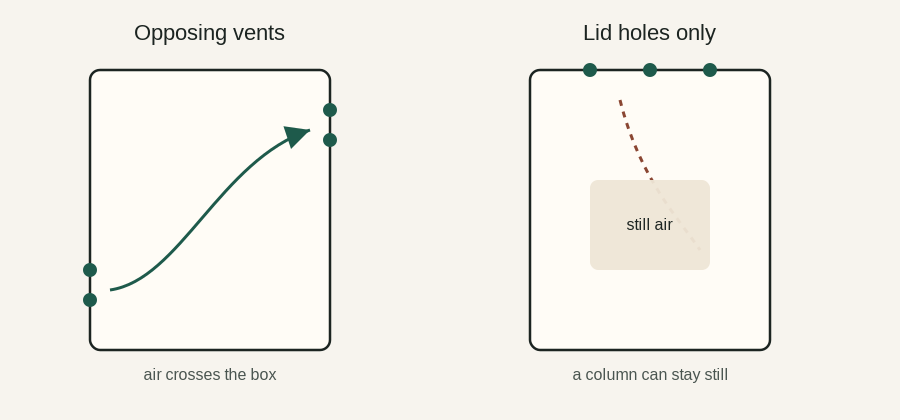
What the guides mean by cross-ventilation
Florida Regal Jumpers asks for plenty of cross-ventilation so the spider can get air and so mold and bacteria are less likely. Steele’s says ventilation is the main defense against mold, and says to increase ventilation or mist less if the enclosure stays wet. AK Spood wants holes on at least two opposite sides, and treats constant heavy fogging as a sign of poor airflow. The RRE PDF asks for fine cross-ventilation on opposing sides and says persistent condensation, a sour smell, flooded soil, or surfaces that never dry are a setup problem. It also says not to fix humidity by sealing every vent. Florida Regal Jumpers Steele’s AK Spood RRE PDF
Spooky Sweet Spoods says cross-ventilation has to move enough air and still allow humidity to be maintained. Web Candy says cross-ventilation is there to prevent mold and fungus, either with small drilled holes or with larger opposite cutouts covered in fine mesh. Spooky Sweet Spoods Web Candy PDF
Published hole sizes, and the missing test
| Source | What it says about openings |
|---|---|
| AK Spood | Micro holes or mesh. Holes no larger than a pinhead for early instar slings. The sling should not be able to squeeze through or get stuck. |
| Spooky Sweet Spoods | Drilled holes of either 1 mm or 2 mm, 3D-printed vents with small holes, or mesh such as no-see-um mesh. Holes must be small enough that the spider will not escape. |
| RRE PDF | Fine cross-ventilation. Check every gap against the spider’s actual size. No millimeter maximum is printed. |
| Steele’s | Avoid large gaps the spider can escape through. No millimeter maximum is printed. |
| Web Candy | Small drilled holes, or larger opposite holes covered with fine mesh. “Fine” is not given as a mesh count. |
Unknown. This sample did not find a peer-reviewed maximum hole diameter for P. regius or for fruit-fly feeders. A pinhead and a 2 mm drill are not the same instruction. Report the source you are following, and still look at the spider in the box. A 2 mm hole that a seller lists for a general jumping-spider enclosure can be the wrong hole for an early sling if you are also reading AK Spood’s pinhead limit.
Mesh sold as “no-see-um” is named by Spooky Sweet Spoods and is not measured on this site. A product photo of mesh is not a hole-size certificate.
The door is an escape gap and a hammock problem
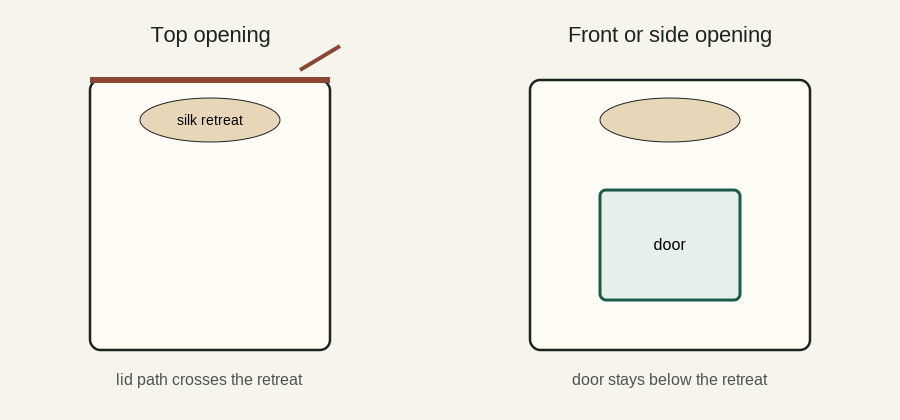
Edwards describes silken nests as ellipsoid, with an opening at each end, used for resting at night, molting, and egg-laying. In captivity the keeper pages call the usual resting silk a hammock and say it ends up high. Edwards, UF/IFAS 2024
- Florida Regal Jumpers: use a side or bottom opening because hammocks tend to be near the top.
- RRE PDF: front, side, or bottom, chosen so the upper hammock is protected.
- Web Candy: front, side, and/or bottom. That sheet says no top openings, because the spider is very likely to build at the highest point and a top door can rip the hammock.
- Spooky Sweet Spoods: bottom or front openings are called best on that page. A top opening is allowed only if the lid is deep enough to hold a hide and will not damage the hammock.
The shared point is the intact upper retreat. The disputed point is whether any top door can do that. Web Candy forbids top openings. Spooky Sweet Spoods allows a deep lid. This site does not pick a hinge brand.
During a molt, the door question gets stricter. Steele’s, AK Spood, Florida Regal Jumpers, and the RRE PDF all say, in their own words, to leave a sealed molt hammock alone. Opening the lid to “just check” is the failure those pages are written against.
Checks before a spider goes in
AK Spood says to test the enclosure first: no squeeze-through holes, no sharp plastic edges, no chemical or pesticide residue, and a lid that snaps or screws shut. The RRE PDF says to check every gap against the individual spider. Steele’s list of things to avoid includes large gaps, poor ventilation, and direct sun. Direct sun is also a heat problem, covered under whether heat is needed.
- Hold the empty enclosure up to a light and look along every seam, hinge, and vent.
- Compare each opening with the spider you have, or with the stricter of the two hole notes above if the animal is an early sling.
- Confirm vents sit on more than one face.
- Find where a hammock can be anchored without sitting in the door’s path.
- Skip the transfer if the spider is sealed in a molt hammock.
Related: acrylic and glass change how a hole is made. They do not change this checklist. The three setups use the same escape test.
Review the setup without diagnosing the spider
Condensation, wet floor material, ignored prey and a visible seam are observations to investigate, not diagnoses. RRE calls persistent condensation, sour odor, flooding and surfaces that never dry setup problems; Steele’s advises reviewing ventilation and excessive misting when the enclosure stays wet. A single wet wall is not a calibrated humidity measurement or proof of one specific cause. RRE PDF Steele’s
| What you observe | What to check in the enclosure | What not to conclude |
|---|---|---|
| Heavy fogging or surfaces that stay wet | Opposing openings, blocked access to vents, amount of water added, wet floor material and room conditions. Do not seal every vent to chase a reading. AK Spood RRE PDF Steele’s | Not a disease diagnosis, and not a reason to invent one humidity percentage for every stage. |
| Repeatedly wet or visibly affected decor | Whether material can be removed without pulling on an occupied retreat, and whether moisture and ventilation need review. Steele’s RRE PDF | Not proof that a cleanup crew or chemical spray will solve the underlying problem. |
| An ignored live feeder | Whether it can be retrieved without disturbing silk. RRE says ignored biting feeders should be removed promptly and none should remain with a sealed molting spider. RRE PDF | Refusal alone does not identify a molt or justify opening a retreat. |
| A visible gap or uncertain mesh opening | Closure fit, seams, lid edges and the individual spider. Return to the hole-size table. AK Spood RRE PDF | No safe universal diameter or material can be inferred from a product photograph. |
Keep the conflicting clocks separate
AK’s uneaten-prey advice and Web Candy’s shorter instruction do not supply one proven safe waiting period. Use the existing prey and hydration discussion for those attributed statements. RRE’s warning about dangerous loose prey and sealed retreats should not be diluted into permission to wait for a longer clock. AK Spood Web Candy PDF RRE PDF
Record observations before changing the design
A useful setup note includes when misting last happened, whether surfaces subsequently dry, where vents and the retreat are, actual room and enclosure readings, visible loose prey and which gaps remain unknown. These are editorial record fields, not a medical checklist or a tested airflow method.
Do not tape over all ventilation to retain moisture, spray mold treatments into the box, or open a sealed retreat to confirm a guess. RRE advises keeping contaminants away and not tearing the retreat open. If maintenance access itself is the problem, use the empty-layout check for the next candidate, not as a reason to dismantle the occupied box immediately. RRE PDF
If the spider is injured or appears unwell, consult a veterinarian who sees invertebrates. The equipment observations here cannot diagnose dehydration, poisoning, a failed molt or old age. For accessible waste and affected decor, start with cleaning around occupied silk.
Frequently asked questions
Does a perforated lid alone establish cross-ventilation?
The opposing-vent pattern described by AK Spood, RRE, and Web Candy is not the same as lid-only holes. Check the layout on more than one face and read the cross-ventilation guidance. The diagram illustrates that pattern; it is not an airflow test.
What is the safe maximum ventilation-hole size?
This sample found no peer-reviewed maximum for this species or its fruit-fly feeders. AK Spood uses a pinhead limit for early slings, while Spooky Sweet Spoods lists different drilled-hole options for enclosures more generally. Read the hole-size conflict table and check against the individual spider; no listed diameter is certified safe here.
Can any top-opening enclosure protect the hammock?
The keeper pages disagree. Web Candy forbids top openings, while Spooky Sweet Spoods allows a sufficiently deep lid that will not damage the hammock. Florida Regal Jumpers favors side or bottom access. The shared goal is an intact upper retreat; see the door comparison.
Should I close all the vents to hold humidity?
No. The RRE PDF says not to seal every vent, and Steele’s says to improve ventilation or mist less when surfaces stay wet. Read the airflow discussion alongside the conflicting humidity and hydration practices, not as a fixed misting recipe.
What should I inspect before putting the spider in?
AK Spood calls for secure closure, no squeeze-through openings, sharp edges, or chemical residue; RRE says to check each gap against the individual. Inspect seams, hinges, vents, and the door path using the pre-enclosure checklist. A product photo is not proof of opening size; the table explains what remains unknown.
Sources on this page
- G. B. Edwards, UF/IFAS EENY-152, revised October 2024. PDF.
- Florida Regal Jumpers care guide. Care guide.
- Steele’s Regal Jumpers care information. Care information.
- AK Spood and Company sling guide. In-depth guide.
- RRE Reptiles regal jumping spider PDF. PDF.
- Spooky Sweet Spoods enclosure requirements. Enclosure requirements.
- Web Candy jumping spider care sheet PDF. PDF.