Acrylic versus glass
The material is not the husbandry.
Acrylic and glass can both make a clear jumping spider enclosure. Public keeper guides in this sample specify doors, vents, and gaps. They do not specify a required plastic or a required glass. The material notes below come from manufacturer sheets, not from a spider trial.
What the sheets report
Two documents are used. Auer Lighting publishes a comparison of its optical glass SUPRAX 8488 with PMMA, the acrylic family, plus other polymers. ACRYLITE Premium (FF) technical information 1121G, marked 08/24, is a sheet for one extruded acrylic. SUPRAX is not every window glass. Where a sentence says “glass,” the citation says which glass.
Swipe the table sideways on a small screen.
| Property | Acrylic / PMMA | Glass in that source | Source |
|---|---|---|---|
| Light transmission | 92% for clear ACRYLITE Premium (FF). 92% for PMMA at 3 mm in the Auer table. | 92% for SUPRAX 8488 at 3 mm. | ACRYLITE 1121G; Auer comparison |
| Density or weight | 1.18 g/cm³ in the Auer PMMA column. ACRYLITE specific gravity 1.19. ACRYLITE states the sheet is only half the weight of glass. | SUPRAX 8488 density 2.31 g/cm³. 1.18 ÷ 2.31 is about 0.51, arithmetic from that table only. | Auer comparison; ACRYLITE 1121G |
| Thermal conductivity | 0.19 W/m·K in both the Auer PMMA cell and the ACRYLITE k-factor. | 1.20 W/m·K for SUPRAX 8488. | Auer comparison; ACRYLITE 1121G |
| Window U-factor | ACRYLITE says its U-factor is approximately 10% lower than glass of the same thickness. | The comparison glass is not named in that sentence. | ACRYLITE 1121G |
| Expansion | Auer lists 80 × 10⁻⁶/K. ACRYLITE says the sheet expands and contracts 3 to 8 times as much as glass or metals. | Auer lists 4.1 × 10⁻⁶/K for SUPRAX 8488. | Auer comparison; ACRYLITE 1121G |
| Moisture movement | ACRYLITE reports dimensional change of 0.2% at 60% relative humidity, 0.3% at 80%, and 0.6% at 100%. | Auer lists water absorption of SUPRAX 8488 as “no,” under ISO 62. The test is not the ACRYLITE humidity test. | ACRYLITE 1121G; Auer comparison |
| Surface and impact | ACRYLITE says the plastic surface is not as hard as glass, and that the sheet is more impact resistant than glass. Past its limit it breaks into comparatively large pieces rather than small slivers. | Auer rates cleanability of SUPRAX “++” and PMMA “−,” and chemical resistivity “++” versus “−.” Those are the page’s symbols, not a score from this site. | ACRYLITE 1121G; Auer comparison |
Do not read the conductivity row as a heater decision
PMMA conducts heat less readily than SUPRAX 8488 in the Auer table. ACRYLITE then says the practical window U-factor is only about 10% lower than glass of the same thickness, because a U-factor includes more than the solid’s k-factor. A small enclosure does not become a safe sunroom because it is acrylic, and it does not become a dangerous sunroom only because it is glass.
The RRE PDF says to avoid direct sun through glass. Steele’s says never to leave the enclosure in direct sunlight because a small enclosure can heat up extremely quickly. Those are keeper warnings about the sun, not a lab comparison of the two materials. Temperature bands and heat stay on the habitat page. ACRYLITE’s continuous-service temperature, listed as 160°F (71°C), is a plastics limit. It is far above the room-temperature bands keepers publish, and it is not a target for a spider.
Holes, doors, and a gap that can move
ACRYLITE 1121G says the sheet can be sawed, drilled, routed, and machined, with tooling kept cool. That is permission to fabricate an acrylic panel. It is not a drilling guide for a spider cage, and this page does not add bit sizes or speeds. The keeper pages describe drilled holes and mesh without naming acrylic or glass. Hole language is unchanged by the brand of sheet.
ACRYLITE also reports that the sheet grows and shrinks with humidity. A door gap measured once, on a dry bench, is not a clearance this site can convert into a safe millimeter. After the box is furnished and misted, look at the gap again. Glass in the Auer table is listed with no water absorption under a different test, and with much lower thermal expansion. A glass seam can still be a bad seam. The spider test is the opening, not the chemistry. Escape checks
Unknown. No husbandry trial in this source set compares acrylic and glass enclosures for P. regius. No source here says one of them is required.
Cleaning without inventing a solvent recipe
Steele’s tells keepers to wipe enclosures with plain or distilled water, and says a 1-part white vinegar to 5-parts water mix can be used for tougher spots if the enclosure is wiped afterward. The same page says never to use harsh chemicals, soaps, detergents, or acetone. Steele’s
The ACRYLITE chemical table codes acetone as N, meaning the sheet is not resistant and can be swelled, attacked, dissolved, or damaged. The same table codes a mild dish-soap solution as R, resistant. Those two documents do not combine into a cleaner. Acetone is a problem for this acrylic sheet. A keeper page also tells people to avoid soaps. This site does not resolve that into a new recipe, and it does not test vinegar on either material.
Material compatibility and occupied-enclosure maintenance are separate questions. For what to reach, what to leave around silk, and why a keeper cleaner is not automatically a verified disinfectant, read cleaning a jumping spider enclosure.
A buying rule that stays inside the sources
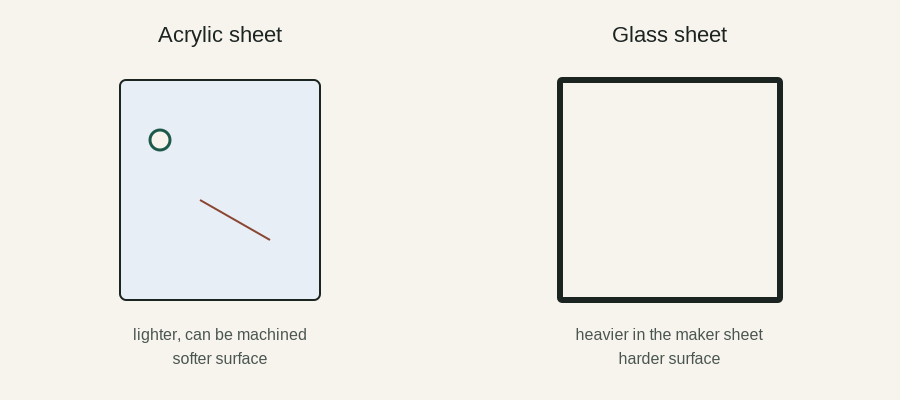
- Choose acrylic when the published reasons you care about are lower weight and the ability to machine vents, as the ACRYLITE sheet describes them, and you will accept a softer surface.
- Choose glass when you want the harder, easier-to-clean surface Auer rates for SUPRAX, and you will still add the cross-ventilation and the safe door the keeper guides describe.
- Reject either listing when the door gap, the hinge crack, or the vent is large enough for the spider. The three setups fail that way in any material.
Sources on this page
- Auer Lighting, “Comparison of Materials,” SUPRAX 8488 versus PMMA and other optical materials. auer-lighting.com. No date was on the page. Read 23 November 2026.
- POLYVANTIS / ACRYLITE, “ACRYLITE Premium (FF) Physical Properties for Extruded Sheet,” technical information 1121G, marked 08/24. PDF.
- RRE Reptiles regal jumping spider PDF. PDF. Direct sun through glass.
- Steele’s Regal Jumpers care information. Care information. Sun warning and the vinegar ratio quoted above.