Habitat setup
Furnish for a retreat, a climb, and a drink.
This page collects sourced practice for substrate, hides, climbing, and water. It does not publish a substrate recipe, a misting calendar, or a heater setting of its own. Where the guides disagree, both versions stay on the page.
What has to be in the picture
In the wild, Phidippus regius uses silk nests rather than a prey web. Nests are where these spiders rest, molt, and lay eggs. Older animals put those nests on palm fronds, under bark, and in cracks in buildings. Edwards, UF/IFAS 2024 Captive guides translate that into an anchor high in the enclosure, something to climb, and enough open space to hunt.
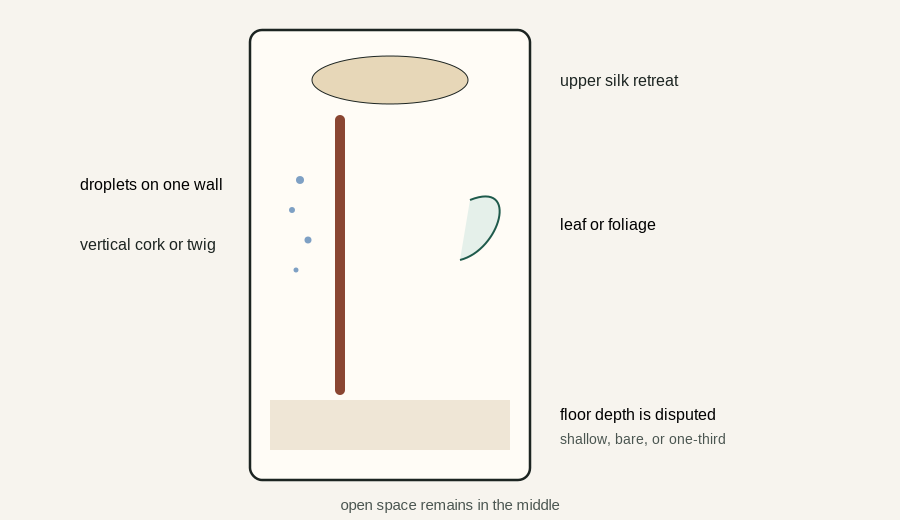
Steele’s says the enclosure needs ventilation, secure openings, climbing surfaces, plants, twigs or cork, hides, and a secure upper area for a hammock, and says not to overcrowd the decor. The Tarantula Collective says to leave room to jump and not to go overboard with plants. The RRE PDF asks for cork, twigs, textured vertical surfaces, foliage, and elevated ledges, with open sight lines and more than one upper retreat, and with every decoration secured. Steele’s Tarantula Collective RRE PDF
Substrate: three practices, not one depth
| Source | What they do |
|---|---|
| RRE PDF | Regals do not need deep substrate. A bare floor, paper towel, or a shallow layer of clean coir or soil can work. A thin layer may buffer moisture and should not stay soggy. The PDF says bioactive setups add complexity for one small spider. |
| AK Spood, slings | Paper towel is described as the most common sling floor. A small amount of clean sphagnum is the alternative. The page says to avoid deep or overly damp substrate. |
| Steele’s | Lists soil as optional. |
| Tarantula Collective, March 2025 | Fills the bottom third with Terra Aranea, slightly damp and never soggy, for spiderlings, juveniles, and adults. That is one bioactive-leaning practice tied to a named mix this site did not test. |
There is no sourced depth in inches that all of these share. “One third” and “shallow or bare” cannot be averaged into a new measurement. If you follow the one-third practice, it is that author’s. If you follow the shallow practice, it is the other guides’. Either way, the pages that mention moisture say the floor should not stay soggy.
Climbing, hides, and materials from outdoors
Florida Regal Jumpers decorates with branches and with fake or real plants, plus a moisture-holding material such as moss or fiber. The page warns that outdoor branches, acorns, wood, and porous materials can carry pesticides or other organisms. It says to bake outdoor material “at a low setting” and then coat it with Mod Podge. It does not publish an oven temperature or a time. This site will not invent either one. The same page says to rinse artificial moss, names E6000, hot glue, and odorless resins as glues that author uses, and says to air the enclosure out for a few days before the spider moves in. Those product names are that page’s list, not a review. Florida Regal Jumpers
The RRE PDF says to avoid sharp gravel, loose fibers that can tangle legs, pesticide-treated plants, sticky tapes, exposed adhesive, and uncured paints or resins. That sits next to Florida Regal Jumpers’ glue list: if a glue is used, the breeder page that names it also says to air the box out, and the RRE PDF says not to leave adhesive exposed or uncured. A cure time beyond “a few days” is not in either document.
AK Spood suggests twigs, cork strips, pesticide-free leaves, and tiny ledges for slings, and says pieces should be secure and not sharp. As spiders age, the RRE PDF says grip can weaken and that intermediate perches shorten falls. That is one guide’s aging note, not a measured fall distance.
One spider per box is the pet-guide pattern. The RRE PDF says to keep one spider per enclosure because they can injure or eat each other. The Tarantula Collective tells breeders to separate spiderlings so they do not eat each other, and to remove a male after mating. Edwards, writing as a naturalist, says adult males often cohabit with subadult females, and sometimes adult females, in order to mate. Wild mating cohabitation and a pet cage for two animals are different situations. A buyer comparing enclosures in this sample is choosing a home for one spider. Edwards, UF/IFAS 2024
Walk through the empty layout before adding the spider
The point of enclosure decor is usable structure, not a full floor or a finished theme. RRE asks for secure routes, upper retreat choices and open sight lines. Steele’s and The Tarantula Collective warn against overcrowding. Edwards’s natural-history account explains why silk matters, but it is not a captive layout blueprint. RRE PDF Steele’s Tarantula Collective Edwards, UF/IFAS 2024
Use this editorial walkthrough while the enclosure is empty:
- Trace the door. Open it through its full intended path. Mark which upper surfaces move with it. Florida’s side/bottom guidance and RRE’s retreat-protecting access describe the goal; they do not guarantee where the spider will anchor silk. See the top-lid disagreement. Florida Regal Jumpers RRE PDF
- Trace the climbing choices. Check that twigs, cork or foliage are firmly placed and do not fall, swing loose or expose sharp parts. RRE favors several routes and upper retreat choices rather than decor that simply fills space. RRE PDF
- Leave some views open. Not every route needs dense cover. RRE recommends open sight lines between some perches, and TTC says to leave room to jump. That is keeper design advice, not a measured spacing formula. RRE PDF Tarantula Collective
- Trace maintenance access. Imagine reaching visible waste, an ignored feeder and the wall used for droplets without detaching the upper structure. The sources ask for accessible cleaning and protected retreats; the walkthrough makes those two needs meet. RRE PDF Florida Regal Jumpers
- Recheck the vents. A clear panel and a decorated corner do not replace opposing ventilation. Keep the intended airflow openings usable and inspect gaps again after adding pieces. RRE PDF
Materials you cannot verify remain a limit. Florida describes outdoor wood treatment and names glues its author uses, but gives no precise baking procedure. RRE warns against pesticides, exposed adhesive and uncured finishes. We do not convert those statements into a safe oven recipe, adhesive list or universal cure time. If the material or its history is unknown, record that rather than calling it safe. Florida Regal Jumpers RRE PDF
Layout questions
Should a hide sit directly on the door? The relevant question is whether normal opening would move the occupied retreat. The cited door guidance aims to protect it; a particular hide position is not certified here. Florida Regal Jumpers RRE PDF
Should every gap between perches be filled? Not according to RRE’s sight-line advice or TTC’s warning against excessive decor. There is no universal perch spacing in the sources used here. RRE PDF Tarantula Collective
Can I rearrange the theme whenever I like? Once silk is occupied, the maintenance problem changes. RRE says to work around retreats rather than tearing them down on a schedule. Read cleaning around silk and planning a move before rebuilding. RRE PDF
Hydration: droplets, dishes, and clocks that do not match
| Source | Water | How often they mention misting |
|---|---|---|
| Steele’s | No water bowl. Droplets on one side. Standing water is on the avoid list, with a drowning concern. | Light mist once a day or as needed, then let it dry. |
| Florida Regal Jumpers | Droplets from mist. Do not spray the spider or the web. Bottled water is what the page names. | The same page says every 3–4 days and, later, every 2–3 days. Both sentences were on the page. More often while molting, with no extra number. |
| RRE PDF | Small droplets on one wall or a few leaves. Open dishes are called generally unnecessary for small individuals and a possible hazard. No honey or sugar water as a routine drink. | Every 1–3 days is called only a starting point. |
| AK Spood, slings | Light mist, not aimed at the sling. Around 50–60% relative humidity on that page, and around 60% during a molt in one section. | Every 1–2 days is “usually enough” on that page. |
| Web Candy PDF | Distilled water on the undecorated side. Droplets “no larger than about a quarter of the size of your jumping spider” is that sheet’s instruction, not a measured limit from a study. The sheet says large drops can drown a spider. | Every few days when not molting. The sheet’s own humidity figures are 50–60%, and 70–80% while molting. |
| Tarantula Collective | Mist droplets for spiderlings. A water dish for juveniles. A larger dish low and a smaller dish higher for adults. Humidity listed as 65–75%. | Misting is described for spiderlings. A day count for adults is not the center of that section; the dishes are. |
Humidity percentages in this set run from about 50–60% (Florida Regal Jumpers, AK Spood, Web Candy outside a molt) through roughly 50–70% (RRE PDF) to 65–75% (Tarantula Collective). Web Candy raises the figure to 70–80% during a molt. Steele’s does not print a percentage. These are keeper targets. EENY-152 does not publish a captive humidity number, so this site will not pretend the extension service chose one.
Feeding amounts are outside this setup page. The enclosure-relevant overlap is prey left in the box and a sealed hammock. The RRE PDF says no live prey should remain with a spider sealed into a molt hammock. AK Spood says to remove uneaten food after 24 hours. Web Candy says not to leave live prey longer than 1–2 hours. The clocks disagree, so they are not merged here. Both the 24-hour instruction and the 1–2-hour instruction tell the keeper to take unused prey out, and the molt pages say to leave the hammock shut.
Whether heat is needed
Heat is a room question first. Several guides say ordinary household temperatures are the starting point, and then they print different bands. Measure the room you have. If it already sits inside the band of the guide you are following, that guide is not asking you to buy a heater. If it sits outside, the guides that mention a device do not agree on the device.
| Source | Band they printed | What they say about a heat device |
|---|---|---|
| Florida Regal Jumpers | Room temperature, 65–78°F. They note the species is native in Florida. No Celsius figure on the page. | No heater product. Do not treat the number as fragile, in their words. |
| Steele’s | About 70–80°F (21–27°C). | Avoid a heater, an air conditioner, direct sun, a drafty window, and large swings. The page says a small enclosure in direct sun can heat up quickly enough to be dangerous. |
| Tarantula Collective | 68–76°F (20–24°C). | No heat-mat instruction in the temperature section read for this page. |
| RRE PDF | Daytime 72–80°F (22–27°C), with a modest night drop toward 68–74°F (20–23°C). “Ordinary room conditions often suffice.” | Do not use bottom heat. Do not use a strong basking lamp over a tiny enclosure. If the room is too cold, stabilizing the room is described as easier to control than heating the small enclosure directly. |
| AK Spood, slings | 75–85°F (24–29°C). | A heat mat or cable on the side of a rack if needed, not underneath. This band is warmer than the other rows. |
| Web Candy PDF | “Around 70 F,” and a preference for the lower end rather than overheating. | Do not set the enclosure on a heat mat or next to a hot window. The sheet says heat mats do not provide steady, safe temperatures. |
Decision. A heater is not part of the three enclosure setups by default. Add a heat plan only after you compare your room with a specific row above, and only with the method that row allows. AK Spood’s side mat, the RRE PDF’s “heat the room instead,” and Web Candy’s “no heat mat” are three different answers. This sample does not sell a mat and does not average 65°F and 85°F into a new target.
Direct sun is the point of agreement: keep the enclosure out of it. That warning is in Steele’s, the RRE PDF, Florida Regal Jumpers’ general care tone, AK Spood, and Web Candy.
Light, without a UVB claim
Edwards says P. regius uses vision to find prey and mates, and that these spiders jump on their prey. That is daylight hunting, not a lamp specification. Edwards, UF/IFAS 2024
Steele’s suggests about 10–12 hours of light and 12–14 hours of dark. The RRE PDF says about 12 hours of bright, diffuse visible light and then darkness, and says a cool-white LED can support hunting without heating the box. The same PDF says jumping spiders can perceive ultraviolet wavelengths and that this perception does not demonstrate a pet requirement for a UVB lamp. Routine reptile-style UVB is not part of that guide. Web Candy also describes a 12-hour LED schedule and says the light should be bright and not hot. RRE PDF Web Candy PDF
No vision paper was read for this page beyond the natural-history statement in EENY-152. The no-routine-UVB sentence is one care PDF’s recommendation.
Cleaning that stays sourced
Florida Regal Jumpers spot-cleans with a cotton swab and removes dead prey. Steele’s uses plain or distilled water, allows a 1:5 white-vinegar wipe if it is wiped off after, and rejects harsh chemicals, soaps, detergents, and acetone. The acrylic sheet cited on the materials page rates acetone as damaging to that acrylic. Vinegar itself was not tested on acrylic or glass for this site.
For an occupied enclosure, the next question is what you can reach without pulling on a retreat. The cleaning guide separates accessible waste, ignored live prey, affected decor and unverified disinfection claims. It gives no new chemical recipe or fixed teardown calendar.
If an animal is injured, stuck in a molt, or not moving, contact a veterinarian who sees invertebrates. This page is not a treatment guide.
Next: the species account these setup choices are tied to, Phidippus regius.
Frequently asked questions
How deep should the substrate be?
There is no single depth across these guides. RRE allows a bare floor or a shallow layer, AK Spood describes simple sling floors, and The Tarantula Collective uses a deeper substrate approach. Keep those practices separate in the substrate table; this site does not make a new recipe from them.
Does a regal jumper need a water dish?
The guides disagree. Steele’s advises droplets rather than a bowl, RRE calls open dishes generally unnecessary for small individuals and a possible hazard, while The Tarantula Collective supplies dishes for older stages. Read the hydration table without turning one practice into a universal rule.
Is there one misting schedule and humidity target?
No. AK Spood, Florida Regal Jumpers, Web Candy, RRE, and The Tarantula Collective publish different practices; Steele’s does not give a humidity percentage. The hydration comparison keeps the clocks and targets separate. EENY-152 supplies no captive humidity target.
Should a new setup automatically include heat?
No. Measure the room first. Several guides start from household conditions, but their bands and device advice differ; Web Candy rejects heat mats and RRE rejects bottom heat, while AK Spood describes conditional side heating for a rack. See the temperature and device table; no default heater is selected here.
Can two spiders share the display enclosure?
For the pet setups compared here, RRE says one spider per enclosure because they can injure or eat each other. Edwards’s observations of mating-related cohabitation in the wild are a different context. See the cohabitation explanation; the size table is not a shared-housing calculation.
Sources on this page
- G. B. Edwards, UF/IFAS EENY-152, revised October 2024. PDF.
- Steele’s Regal Jumpers care information. Care information.
- The Tarantula Collective, Phidippus regius care sheet, revision March 2025. Care sheet.
- RRE Reptiles regal jumping spider PDF. PDF.
- Florida Regal Jumpers care guide. Care guide.
- AK Spood and Company sling guide. In-depth guide.
- Web Candy jumping spider care sheet PDF. PDF.