Sling versus adult
Size the spider you have, then the box.
Adult Phidippus regius body length is a measured range. Enclosure inches are keeper reports, and they do not land on one number. This page keeps those two kinds of fact apart.
Body length is not the enclosure
Edwards, in the October 2024 revision of UF/IFAS EENY-152, gives adult body length with the legs excluded. The publication also prints inch glosses. Those glosses are quoted as printed. This site does not “correct” them.
| Adults | Average | Range | Source wording for inches |
|---|---|---|---|
| Males | 12 mm | 6 to 18 mm | 1/2 in average; range written 1/4–3/4 in |
| Females | 15 mm | 7 to 22 mm | 2/3 in average; range written 1/4–7/8 in |
A 2017 note in the Journal of Arachnology, coauthored by Edwards, repeats the maxima as 2.2 cm for females and 1.8 cm for males. It adds that large females have a leg span approaching 3.5 cm and the largest males may exceed 4 cm, with less body mass than females. Adult female mass is given as about 0.5 to 1 g, citing earlier Anderson papers. The same note says these spiders can jump more than their body length straight up a vertical surface, attributed to Edwards’s 1980 dissertation. This sample did not re-read that dissertation. Nyffeler, Edwards, and Krysko 2017
Unknown. EENY-152 does not give body length for each instar. A seller’s “i4” or “i6” cannot be converted into millimeters from the sources on this page. Instar labels below are the words the keeper guides use.
The wild shift is upward, and it is not a cage height
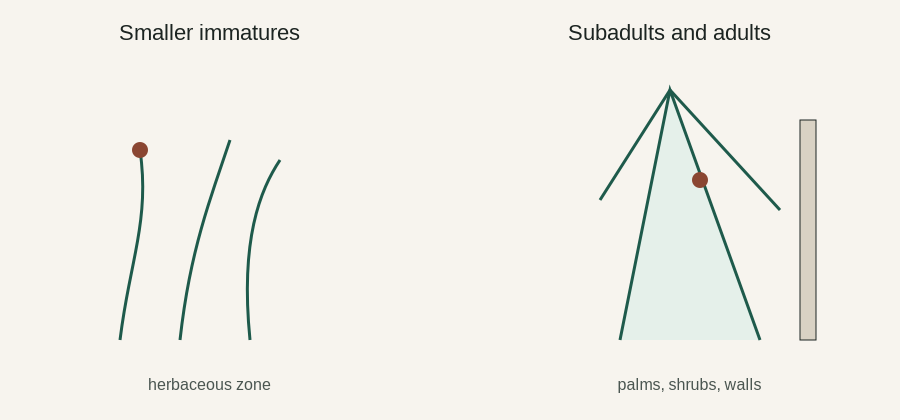
Smaller immatures are usually found in the herbaceous zone. Subadults and especially adults favor palms and palmettos in semiarid habitats. Where palms are absent, older stages use shrubs and trees. Adults often use relatively flat surfaces and are frequently found on walls of buildings. Edwards, UF/IFAS 2024
Juveniles may nest in the tops of herbs or in rolled leaves. Subadults and adults frequently nest along the inner mid-veins of palm fronds. The 2017 paper, citing Edwards 1990, says adults often use small palms and palmettos about 1.0 to 3.0 m high. That is a wild perch. It is not an instruction to build a 3-meter enclosure, and it is not evidence that an 8-inch box matches a palm.
Keeper-reported enclosure sizes
Each row is one document. Do not average the rows into a new “ideal.”
| Source | Who they are sizing | What they printed | Limit of that claim |
|---|---|---|---|
| AK Spood | Most jumping-spider slings | About 2 × 2 × 3 in, tall. Move up around i5 or i6. | One breeder’s sling guide. Not limited to P. regius on the page. Undated. |
| Florida Regal Jumpers | Regal slings, then subadults and adults | Small deli cup for slings. Author has used 4 × 4 × 8 and 5 × 5 × 9 for subadults and adults. | Personal experience. The page says other sizes can work. Undated. |
| Spooky Sweet Spoods | Slings through juveniles, or smaller species; then subadults and adults | 4 × 4 × 4 in for the first group. 4 × 4 × 8 in, or a second size written “6″W × 6″W × 9″H,” for subadults and adults. | Seller enclosure page. The duplicated W is left as printed. Undated. The 4 × 4 × 4 sling-to-juvenile box is larger than AK Spood’s 2 × 2 × 3. |
| Web Candy PDF | Phidippus about i5 to i7, then adults | 4 × 4 × 4 or 3 × 3 × 6 in up to about i6 or i7. Calls 4 × 4 × 8 in the minimum for an adult. | Seller sheet. No author or date in the file. “Minimum” is their word. |
| Steele’s | Adult regals | Ideal adult size 4 × 4 × 8 in to 6 × 6 × 9 in. Taller is preferable to wide and flat. | Breeder page. Undated. “Ideal” is their word. |
| RRE PDF | Adult regals; spiderlings called out separately | 4 × 4 × 8 in (10 × 10 × 20 cm) as a useful starting adult size. Larger females roughly 6 × 6 × 9 in (15 × 15 × 23 cm). Spiderlings need a scaled box. | No author or date in the file. Centimeter figures are the PDF’s, not a conversion added here. |
| Tarantula Collective, March 2025 | Adult P. regius in that author’s care | Says an 8-inch-tall enclosure is debated. He uses a Large Treehouse and sometimes a 12-inch cube, and says he would not go smaller than a Medium Treehouse. | One keeper. Named products were not measured for this site. He also says smaller setups are not necessarily wrong. |
When the guides say to move the spider
AK Spood lists signs for a larger sling box around i5 or i6: webbing on every surface, trouble catching prey in tight quarters, body size nearing half the enclosure width, or repeated escape attempts. Those signs are that page’s, not a scoring rubric from the extension service.
Do not treat a move as urgent during a molt. AK Spood says to leave a molting sling undisturbed. Steele’s says not to handle, poke, feed, or pull a molting spider out of the hammock. Florida Regal Jumpers says not to force a spider out of its web. The RRE PDF says not to tear open a sealed molt retreat. The hours they attach to feeding around a molt are not the same, so this page does not publish a blended waiting time. The door page is the enclosure half of that advice: do not open through the retreat.
A reason to consider more space is not a transfer procedure. Keep this page’s stage and size evidence separate from the practical move: prepare the next enclosure and plan an unforced transfer. That guide keeps the no-disturbance boundary, source differences and the lack of a universal post-molt timer intact.
Rehousing gap. None of these sources publishes a tested maximum enclosure volume for an adult regal. The Tarantula Collective prefers more room than the 8-inch discussion. Other regal pages publish the 4 × 4 × 8 to 6 × 6 × 9 band and stop there. Both statements can be reported. Neither one becomes this site’s law.
Next: which of the three setups matches the stage, then whether the vents are smaller than the spider.
Frequently asked questions
Is there a scientifically established pet-enclosure size for a regal jumper?
No peer-reviewed required pet-enclosure size was found in this source set. UF/IFAS EENY-152 supplies body lengths and natural-history observations, not a captive cage standard. The body-length table and keeper enclosure table deliberately keep those claims apart.
Do all sling guides specify the same size?
No. AK Spood’s sling box and Spooky Sweet Spoods’ sling-to-juvenile box differ, while Florida Regal Jumpers starts with a small deli cup. Compare the attributed rows in the keeper size table; do not average them into a new recommendation.
Is one adult enclosure height agreed by all keepers?
No. Florida Regal Jumpers and Steele’s describe smaller adult boxes than the larger setups used by The Tarantula Collective, whose care sheet acknowledges the height debate and says smaller setups are not necessarily wrong. See the adult rows and the rehousing gap; no tested maximum adult volume was found.
Can an instar label be converted directly into body length?
Not from these sources. EENY-152 gives adult body-length ranges, not lengths for every instar. The instar labels in the keeper table remain those authors’ labels. See the body-length limitation before interpreting a seller’s stage label.
Should I rehouse a spider that has sealed its molt hammock?
The cited AK Spood, Steele’s, Florida Regal Jumpers, and RRE guidance says to leave the molting animal and retreat undisturbed. Read when the guides say to move and the door guidance. This page does not merge their different post-molt timing instructions.
Sources on this page
- G. B. Edwards, UF/IFAS EENY-152, revised October 2024. PDF.
- M. Nyffeler, G. B. Edwards, and K. L. Krysko, Journal of Arachnology 45:238–241, 2017. PDF.
- AK Spood and Company sling guide. In-depth guide.
- Florida Regal Jumpers care guide. Care guide.
- Spooky Sweet Spoods enclosure requirements. Enclosure requirements.
- Web Candy jumping spider care sheet PDF. PDF.
- Steele’s Regal Jumpers care information. Care information.
- RRE Reptiles regal jumping spider PDF. PDF.
- The Tarantula Collective, Phidippus regius care sheet, revision March 2025. Care sheet.