Jumping spider enclosure

Choose the enclosure for the spider in front of you.

A jumping spider enclosure is a height, a door, and a set of gaps. This sample walks that choice for Phidippus regius, the regal jumping spider, using a university natural-history profile and public keeper guides. It is not a shop and not a care blog.

Smaller immatures are usually in the herb layer. Older animals use palms, shrubs, trees, and walls. They rest, molt, and lay eggs in silk nests, and they do not build a web to catch prey. Edwards, UF/IFAS 2024

Start with two facts

This routes you to a sourced page. It does not match you to a product.

Next, before any buying link: read the checks below, then the matching setup explanation. These checks apply to every result.

Do this first / Don’t do this yet

Do this first

  • Identify the spider’s current life stage; compare the keeper-reported size table before choosing a setup (AK Spood and Florida Regal Jumpers).
  • Inspect the empty box along every seam, hinge, lid, and vent. Check each opening against the individual spider, not a product photo; see the hole-size table (AK Spood and RRE PDF).
  • Check for opposing vents, a closure that shuts securely, and no sharp edges or chemical residue. Find an upper hammock anchor outside the door’s path; see the sourced pre-enclosure checks.

Don’t do this yet

  • Do not move a spider sealed in a molt hammock or open through its retreat (AK Spood, Steele’s, Florida Regal Jumpers, and RRE PDF); read the door and molt guidance.
  • Do not assume an adult display box suits a sling; the starter explanation records why the sling guides keep the space manageable.
  • Do not add heat by default, put the box in direct sun, or seal all vents to chase humidity. Compare the temperature table and airflow guidance before changing the setup.
How to read a product listing

Use this checklist before following any placeholder link. A seller’s claim is not a measurement by this site.

  1. Door: where does it open, and does that path cross the upper retreat? Florida Regal Jumpers and the RRE PDF favor access that protects it; see the door guidance and top-lid disagreement.
  2. Cross-ventilation: look for opposing vents, not just a clear window or a perforated lid. See AK Spood, Web Candy, and RRE’s airflow guidance.
  3. Stated size: find height and footprint, then compare the source-by-source size table. Do not treat a brand name or a wild perch height as a captive standard.
  4. Life stage: find which animal the seller claims the box suits. Check it against the three-setup comparison, not the adult the sling may become.
  5. Gaps: look for a stated hole or mesh size and inspect seams and closure gaps. If a listing is silent, the size is unknown; see the published opening notes and their limits.
  6. Heat assumptions: is a heater bundled as if every enclosure needs one? Start with the room and the conflicting keeper temperature bands, not a default add-on.

Next: read the starter, vertical adult, or viewing-window explanation. Any example.com link comes after that judgment. No brands or star ratings are tested here.

The form needs JavaScript. The four steps below work without it.

A jumping spider enclosure: agreed / still disputed

Shared themes in the cited keeper guides, not a laboratory standard. This decision guide is limited to the regal jumping spider and the life stages those sources describe.

Agreed: start here

Still disputed: keep the source attached

Four decisions, in order

1

Life stage

Sling, juvenile, or subadult and adult. Size the animal you have, then read who each setup is for. Sling versus adult.

2

Height and door

Older regals use elevated nests. Pick a door that does not tear that silk. Three setups.

3

Air and gaps

Cross-ventilation, with every opening smaller than the spider you have. Ventilation.

4

Heat, or not

Several guides start from room temperature. Their degree bands do not match. Heat.

The three setups

Recommended here means the setup matches the life stage those keepers describe. It is not a product award. Dimensions are theirs, quoted, not remeasured by this site.

01

Starter small enclosure

For a sling. A small deli cup or a box on the order of 2 × 2 × 3 inches in the sling guide. Leave the adult towers for later.

Why this one, and not the other two

02

Vertical adult enclosure

For a subadult or adult regal, in the keeper band of about 4 × 4 × 8 to 6 × 6 × 9 inches, with a side, front, or bottom door.

Why this one, and not the other two

03

Viewing-window enclosure

For an established juvenile or adult when a clear front is the point. More volume to verify, not a higher score.

Why this one, and not the other two
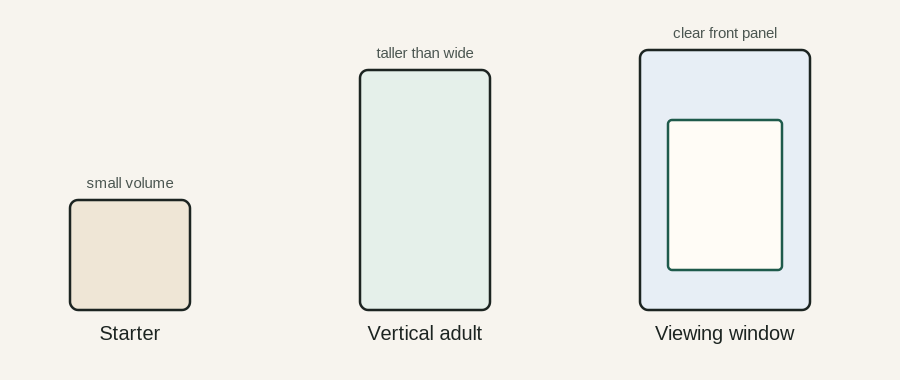
Diagram of three enclosure outlines: a short starter box, a tall narrow adult box, and a taller box with a clear front panel. Proportions are schematic, with no inch scale.
Diagram, not a photograph and not a tested setup. The outlines show the decision, not a scale drawing of any cage.

Put the enclosure decision into practice

Choose the job you need to do next. These guides turn the source comparisons into planning and maintenance questions, without adding a universal cage formula.

  • Before you buy: Prepare a supplies checklist. Match tools and structure to a task; keep heat and elaborate displays conditional.
  • Before you reuse a container: Evaluate a DIY candidate. Inspect the empty box, access and unknown gaps. This is not an untested drilling recipe.
  • With a spider already inside: Clean around occupied silk. Separate reachable mess from work that would disturb a retreat.
  • When considering a move: Plan rehousing. Prepare the next box first, and do not force a sealed spider out.
  • When planning decor: Walk through the empty layout. Check upper anchors, door movement, open routes and maintenance access.
  • When the box stays wet: Review the setup. Record ventilation, moisture, loose prey and gaps without diagnosing the spider.

What a generic cage leaves out

A short, wide box misses the pattern in the sources below. The extension profile puts older P. regius on palms, palmettos, shrubs, trees, and building walls, and it describes ellipsoid silk nests used at night, for molting, and for eggs. Edwards, UF/IFAS 2024

Keeper pages then add the captive version of that pattern: vertical space, a retreat near the top, and a door that does not open through that retreat. Florida Regal Jumpers Steele’s RRE Reptiles PDF

Acrylic and glass can both be clear. Neither material answers the gap question. Acrylic versus glass.

Substrate depth, water dishes, and heater use are published as conflicting keeper practice. Habitat setup keeps those conflicts visible.

What this sample will not do

Frequently asked questions

What makes a suitable jumping spider enclosure?

For the regal jumping spider covered here, the cited keeper guides emphasize current life stage, cross-ventilation, secure gaps, and access that spares the upper silk retreat. Florida Regal Jumpers and RRE supply those practical checks. Start with the keeper size table and the opening notes; neither gives this site a universal cage standard.

Why choose for the current life stage rather than the adult?

Florida Regal Jumpers starts slings in a small deli cup; AK Spood says an oversized sling box makes feeding harder. Their stage-specific advice is collected beside the differing juvenile sizes in the size table. It is not a formula for every jumping-spider species.

Should the enclosure open from the side or bottom?

Florida Regal Jumpers recommends side or bottom access because hammocks tend to be high. The RRE PDF also allows front access that protects that retreat. Top-opening guidance differs between Web Candy and Spooky Sweet Spoods; read the door comparison rather than assuming every lid is safe.

Is a heater part of every setup?

No. Heat is not a default add-on. Florida Regal Jumpers, Steele’s, and RRE start with household or room conditions but publish different bands; AK Spood’s sling band is warmer. Measure the room and read the temperature table. This sample does not supply a blended target or heater setting.

Which care details are still disputed?

Sling dimensions and adult height differ in the keeper size table; opening advice differs in the hole-size table. Temperature, humidity, and hydration practice also differ in the heat and water comparisons. These are attributed keeper reports, not an extension-service captive standard.

Sources on this page

  1. G. B. Edwards, “Regal Jumping Spider, Phidippus regius,” UF/IFAS EENY-152, revised October 2024. ask.ifas.ufl.edu PDF. Range, body length, habitats, and silk nests.
  2. Florida Regal Jumpers, “Care Guide.” floridaregals.com/careguide. No date was on the page. Sling cup, adult sizes the author has used, cross-ventilation, side or bottom opening.
  3. Steele’s Regal Jumpers, “Care Information.” steelesregaljumpers.com/care-info. No date was on the page. Adult size band, vertical preference, ventilation.
  4. RRE Reptiles, “Regal Jumping Spider Care Guide” PDF. rrereptiles.com PDF. No author or date was printed in the file. Adult starting size and door guidance.

Full ledger, including pages not cited here: methods and sources. Access date for every source: 23 November 2026.