One species
Phidippus regius, and the enclosure that follows from the record.
The regal jumping spider is the species this sample can document. The extension profile is natural history. The inch sizes are keeper guides. Both are cited. Neither is a veterinary protocol, and this page does not sell animals.
What the extension profile establishes
Except for two pantropical species, Edwards calls P. regius the jumping spider most often encountered in Florida, and the largest jumping spider in eastern North America. The species is found in the southeastern United States, the Greater Antilles, and the Bahamas, and it is most common in peninsular Florida. Edwards, UF/IFAS 2024
Adult males average 12 mm in body length, range 6 to 18 mm. Adult females average 15 mm, range 7 to 22 mm. Males are black with white markings and iridescent chelicerae. Females are often covered in gray, tan, brown, or orange scales, especially in the southern two-thirds of Florida and in the Greater Antilles. The publication says this is one of the few spiders that can be sexed in early instars in more southern populations, with females gaining scale cover as early as the third instar and males staying black and white. It does not give a millimeter length for those instars.
A 2017 Journal of Arachnology paper gives large-female leg span approaching 3.5 cm, the largest males possibly exceeding 4 cm, and adult female mass about 0.5 to 1 g. It also says they live in old-field habitats and often use small palms and palmettos about 1.0 to 3.0 m high as adults, citing Edwards 1990 for that perch. Females nest inside the newest fully developed but unopened leaf, then forage on the trunk, other leaves, and adjacent shrubs. Nyffeler, Edwards, and Krysko 2017 This sample uses that paper for size and perch. It does not turn the paper’s notes on vertebrate prey into a feeding plan.
Where they actually put a nest
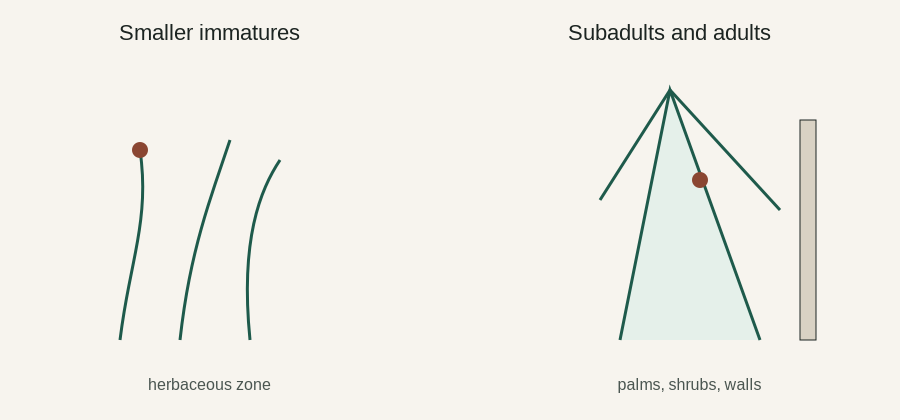
Jumping spiders in this account do not build webs to catch prey. They trail a dragline. The resting structure is a silken nest, ellipsoid, open at each end, used at night, for molting, and for eggs. Juveniles may nest in herb tops or rolled leaves. Subadults and adults frequently nest along the inner mid-veins of palm fronds. Egg-laying females make thick nests under oak and pine bark and in cracks in old houses and barns. Edwards, UF/IFAS 2024
The same profile says the species uses most field and open-woodland habitats and is not found within mature hardwood forest. Adults seem to prefer relatively monoplanar surfaces, including walls. That is a useful check on a box stuffed solid with decor: the wild adults in this account spend time on broad surfaces, while the keeper guides add cork and twigs as anchor points. The RRE PDF’s “routes plus open sight lines” is the captive sentence closest to both observations. Climbing and hides
What that record supports in a cage
- Vertical structure for older animals. The shift from herbs to palms, shrubs, and walls is in the extension profile. Keeper pages then publish taller-than-wide boxes for subadults and adults. Vertical adult setup
- A small volume for early slings. The profile puts smaller immatures in the herb layer and does not give them the palm perch. The sling-cup guidance is keeper practice, matched to that early stage rather than copied from a palm. Starter setup
- An upper retreat you can leave closed. Nests are for rest, molt, and eggs. A door through that silk works against the behavior the profile describes. Door and hammock
- Not a burrow-first layout. The published nest sites are on plants, fronds, under bark, and in building cracks. Edwards does not describe a soil burrow as the residence. A deep fossorial cage is a different animal’s design. Substrate depth in captivity is still disputed; see the habitat table.
- One spider for a buyer using the pet guides. Edwards documents male-female cohabitation around mating. The RRE PDF and The Tarantula Collective describe individual housing, and the latter says to separate spiderlings. This comparison is for one enclosure, one spider.
- Daylight, not a heat lamp. They hunt by sight in the daytime. Lamp guidance from keepers is on the light section. Sun on a small box is a heat warning, not a basking plan.
Edwards writes that a larger jumping spider such as P. regius can deliver a painful bite if it is held tightly. This site does not give medical advice. Someone who is bitten and needs help should contact a clinician. A secure door is the point of the enclosure pages, so handling is optional rather than required.
Keeper housing, kept in its own column
For subadult and adult regals, Florida Regal Jumpers reports 4 × 4 × 8 and 5 × 5 × 9 inches as sizes that author has used. Steele’s prints 4 × 4 × 8 to 6 × 6 × 9 inches. The RRE PDF prints 4 × 4 × 8 inches as a starting adult size and roughly 6 × 6 × 9 inches for larger females. The Tarantula Collective, March 2025, argues for larger cages and names a 12-inch cube among the enclosures he uses. Those sentences are linked from the size table. They are not in EENY-152.
Lifespan is another keeper-only figure. EENY-152 does not give one. Florida Regal Jumpers says males live 1–2 years and females 1–3 years, with 3 years called rare. The Tarantula Collective says 1–3 years, females longer. The RRE PDF says an average of 1–2 years. Report the guide. Do not merge them.
Clutch size is natural history, not a breeding lesson. EENY-152 says females lay up to four batches, the first averaging 183 eggs, an average total of 402 if four batches are laid, and a calculated maximum of 715, citing Edwards 1980. It also cites Anderson 1978 for one sac of 570 eggs. A wild-caught adult female can therefore become a housing problem measured in hundreds of spiderlings. This page stops there. It does not explain incubation or shipping.
What is thin, and what was not invented
- UF/IFAS EENY-152 is not a pet-care manual. It has no captive temperature, humidity, or enclosure dimension.
- No paper in this set sets a required pet-cage size.
- Instar-by-instar body lengths are absent, so “i5” is not converted to millimeters.
- The 1.0–3.0 m palm figure is a wild perch, cited at second hand through the 2017 paper’s reference to Edwards 1990. It was not remeasured.
- Keeper temperature bands disagree, from 65°F at the low end of one guide to 85°F at the high end of the sling guide. They are tabulated on the heat section and not averaged.
- Other jumping-spider species are out of scope. P. audax and P. otiosus are named only so a misidentification is not given this species’ adult inches.
Use the three-setup comparison after this page, not instead of the disagreements it links.
Sources on this page
- G. B. Edwards, “Regal Jumping Spider, Phidippus regius C. L. Koch (Arachnida: Salticidae),” UF/IFAS EENY-152. Original September 2000, revised December 2005 and October 2024. ask.ifas.ufl.edu PDF.
- M. Nyffeler, G. B. Edwards, and K. L. Krysko, “A vertebrate-eating jumping spider (Araneae: Salticidae) from Florida, USA,” Journal of Arachnology 45:238–241, 2017. PDF.
- Florida Regal Jumpers care guide, for the lifespan sentence and the adult inches summarized above. Care guide.
- The Tarantula Collective care sheet, revision March 2025, for the larger-enclosure practice and the 1–3 year lifespan sentence. Care sheet.
- RRE Reptiles PDF, for the 1–2 year average and the adult inches summarized above. PDF.