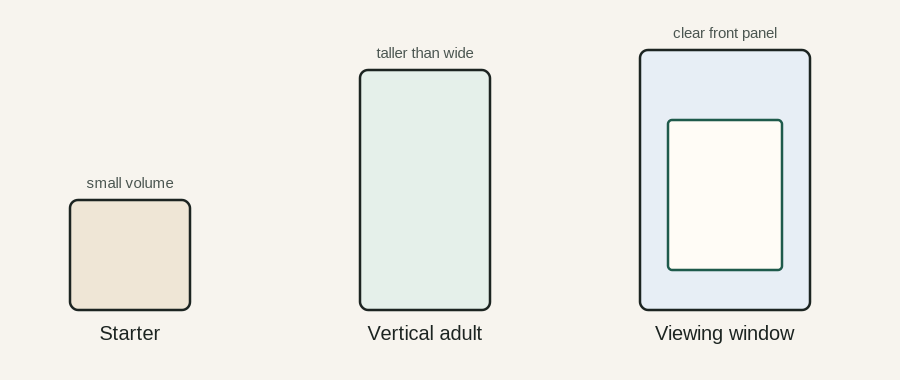
These are the three jumping spider enclosures this sample asks you to decide between. Recommended means the setup matches the life stage in the keeper guides cited under it. It does not mean a laboratory ranked three products.
Affiliate disclosure: the example.com links below are placeholders with no affiliate ID or commission; this sample does not sell anything.
Do this first / Don’t do this yet
Do this first
Identify the spider’s current life stage; compare the keeper-reported size table before choosing a setup (AK Spood and Florida Regal Jumpers).
Inspect the empty box along every seam, hinge, lid, and vent. Check each opening against the individual spider, not a product photo; see the hole-size table (AK Spood and RRE PDF).
Check for opposing vents, a closure that shuts securely, and no sharp edges or chemical residue. Find an upper hammock anchor outside the door’s path; see the sourced pre-enclosure checks.
Don’t do this yet
Do not move a spider sealed in a molt hammock or open through its retreat (AK Spood, Steele’s, Florida Regal Jumpers, and RRE PDF); read the door and molt guidance.
Do not assume an adult display box suits a sling; the starter explanation records why the sling guides keep the space manageable.
Do not add heat by default, put the box in direct sun, or seal all vents to chase humidity. Compare the temperature table and airflow guidance before changing the setup.
How to read a product listing
Use this checklist before following any placeholder link. A seller’s claim is not a measurement by this site.
Door: where does it open, and does that path cross the upper retreat? Florida Regal Jumpers and the RRE PDF favor access that protects it; see the door guidance and top-lid disagreement.
Stated size: find height and footprint, then compare the source-by-source size table. Do not treat a brand name or a wild perch height as a captive standard.
Life stage: find which animal the seller claims the box suits. Check it against the three-setup comparison, not the adult the sling may become.
Gaps: look for a stated hole or mesh size and inspect seams and closure gaps. If a listing is silent, the size is unknown; see the published opening notes and their limits.
Heat assumptions: is a heater bundled as if every enclosure needs one? Start with the room and the conflicting keeper temperature bands, not a default add-on.
Next: read the starter, vertical adult, or viewing-window explanation. Any example.com link comes after that judgment. No brands or star ratings are tested here.
Still planning the setup? Use the supplies checklist to separate essentials from optional extras. Assessing a reused container? Use the DIY evaluation before assuming a clear box is ready. If the spider already has a home, read the rehousing workflow before changing it.
Diagram, not a photograph and not a tested setup. Inch figures stay in the table, attributed to the guide that printed them.
01
Starter small enclosure
For Early Phidippus regius slings, and the sling stage AK Spood discusses for jumping spiders generally. Not a smaller adult of another species unless you have a source for that species. This site does not.
What the guides actually say
Florida Regal Jumpers keeps slings in a small deli cup with a twisted pipe cleaner or a small branch, and keeps the cup fairly bare so the spider can climb and build a hammock. Florida Regal Jumpers
AK Spood calls about 2 × 2 × 3 inches, tall, a useful size for most slings, with a tight lid and ventilation holes no larger than a pinhead for early instars. The same page says a sling may be ready to move up around i5 or i6. AK Spood
The RRE PDF says very small spiderlings need a rearing box scaled to them and escape-proof, and it gives the 4 × 4 × 8 inch figure as a starting adult size. RRE PDF
Ventilation and door
The sling guides ask for cross-ventilation and a lid that actually closes. AK Spood wants holes on at least two opposite sides, micro-sized or meshed. The door style at this stage is often a lid on a cup. That lid can still sit on a hammock: slings build silk high in the container. AK SpoodFlorida Regal Jumpers If you use a top lid, read the door warning on the ventilation page before you pop it open.
Why not the vertical adult enclosure
Florida Regal Jumpers moves subadults and adults into boxes the author has used at 4 × 4 × 8 and 5 × 5 × 9 inches, and says a box that is too big is one where the spider has trouble finding a meal or water. AK Spood says a too-large sling enclosure makes feeding difficult and can leave the sling struggling to find prey or a place to molt. Those are the reasons to leave the adult tower until the animal matches the stage those guides move.
Why not the viewing-window enclosure
The viewing setup is the larger, clearer end of keeper practice, including enclosures The Tarantula Collective describes for adult regals. A sling is the life stage the small-box guides are written for. Extra door hardware is also extra gap to check, and the sling guides make gap size the constraint. Escape-proofing
For Subadult and adult P. regius. Edwards reports that these older stages leave the herb layer for palms, palmettos, shrubs, trees, and walls. Edwards, UF/IFAS 2024 The inch sizes below are keeper reports for regals, not a rule for every salticid.
What the guides actually say
Florida Regal Jumpers: the author has used 4 × 4 × 8 and 5 × 5 × 9 for subadults and adults, and says other sizes can work. Florida Regal Jumpers
Steele’s: an ideal adult enclosure is 4 × 4 × 8 inches to 6 × 6 × 9 inches, and a taller box is preferable to a wide, flat one. Steele’s
RRE PDF: a furnished 4 × 4 × 8 inch box (also written 10 × 10 × 20 cm) is a useful starting adult size; larger females may benefit from roughly 6 × 6 × 9 inches (15 × 15 × 23 cm). RRE PDF
Web Candy calls 4 × 4 × 8 inches the minimum for an adult. That is one seller’s floor, not a measured biological minimum. Web Candy PDF
Ventilation and door
Ask for cross-ventilation on opposing sides, and a front, side, or bottom opening that leaves the upper hammock intact. Florida Regal Jumpers specifies a side or bottom opening because hammocks tend to be built near the top. The RRE PDF says to choose an opening that protects the upper hammock and to check every gap against the spider’s actual size. Steele’s lists secure openings, plenty of ventilation, and no large escape gaps. Florida Regal JumpersRRE PDFSteele’s
Why not the starter
The starter is the sling container in those guides. An adult female in the extension profile can be 7 to 22 mm in body length, and a large female’s leg span is described elsewhere as approaching 3.5 cm. Edwards, UF/IFAS 2024Nyffeler, Edwards, and Krysko 2017 The breeder pages move subadults and adults out of the sling cup and into the taller sizes. Use the starter again only if you are housing a new sling.
Why not the viewing-window enclosure
Choose the vertical adult box when you are following the about 4 × 4 × 8 to 6 × 6 × 9 inch keeper band and you do not need a larger clear front. The Tarantula Collective says some keepers consider an 8-inch-tall enclosure enough and that he uses larger cages. That disagreement is real. It is not a defect score against the shorter adult box. If your listing’s main feature is a big viewing panel and a larger footprint, read the third setup and check its gaps. Do not buy it only because the word advanced is on the label.
For An established juvenile or adult P. regius when you want to watch through a clear front. Advanced here means there is more to verify: volume, door gaps, and ventilation. It does not mean a higher score.
What the guides actually say
The Tarantula Collective, revised March 2025, says enclosure size is debated, that some keepers use an 8-inch-tall enclosure, and that he keeps adult P. regius in a Large Treehouse and sometimes a 12-inch cube. He also writes that a smaller enclosure is not necessarily wrong. This site did not measure those named products. Tarantula Collective
Spooky Sweet Spoods calls bottom- or front-opening enclosures the best option on that page, which is a seller’s judgment. A front panel is the usual way those openings also become the viewing face. Spooky Sweet Spoods
The RRE PDF allows a front, side, or bottom opening if it protects the upper hammock, and it says larger space should still contain upper cover and safe travel routes. RRE PDF
Ventilation and door
A clear front does not replace opposing vents. Steele’s, Florida Regal Jumpers, Spooky Sweet Spoods, and the RRE PDF all ask for cross-ventilation, and they all warn in different words that gaps have to stay smaller than the spider. A sliding or hinged front fails if the crack at the frame fits the animal. Check the frame, the hinge, and the vent mesh against the spider you have, not against a product photo.
Why not the starter
Florida Regal Jumpers and AK Spood both describe a too-large box as a feeding problem for a small spider. Web Candy tells keepers to keep an i5 to i7 Phidippus in a simple 4 × 4 × 4 or 3 × 3 × 6 inch enclosure rather than a large decorated box. The viewing enclosure is the wrong match while the animal is still in that small-box stage.
Why not the vertical adult enclosure
Skip this larger viewing box when the spider is a subadult or adult and your decision is satisfied by the 4 × 4 × 8 to 6 × 6 × 9 inch band. Buy the viewing enclosure when a clear front and the extra room The Tarantula Collective argues for are the features you are choosing with your eyes open about the size debate. Keepers who use the smaller adult boxes are not failing a test this site invented.
Three enclosure decisions. Sizes are quotations, not new measurements.
Question
Starter small
Vertical adult
Viewing window
Life stage
Sling, early spiderling
Subadult and adult P. regius
Established juvenile or adult P. regius
Keeper-reported size
Deli cup; about 2 × 2 × 3 in
About 4 × 4 × 8 in up to about 6 × 6 × 9 in
Larger than that band in one 2025 care sheet, including a stated 12 in cube. Product inches not remeasured here.
Door
Tight lid. Do not rip a hammock on the lid.
Front, side, or bottom, sparing the top retreat
Clear front that still spares the top retreat
Ventilation
Opposing micro holes or mesh. Pinhead limit in one sling guide.
Cross-ventilation. Gaps checked against the spider.
Same cross-ventilation test. A window is not a vent.
Heat
Not a reason to add a heater by itself. See the temperature bands. They disagree.
Pass over it when
The spider is a subadult or adult regal
The spider is still a sling, or you have decided you need the larger viewing volume
The spider is a sling, or the smaller adult band already meets the brief
Affiliate disclosure. The three example.com links on this page are placeholders. They are not merchant accounts, they contain no affiliate ID, and they do not lead to a live-animal market. Jumper Habitat does not take payment.
Known gaps
No peer-reviewed paper in this set states a required pet-enclosure size for P. regius.
Juvenile inch sizes conflict. They are collected on the size page, not averaged.
Commercial product dimensions named by The Tarantula Collective were not measured for this sample.
The RRE PDF and several breeder pages show no author date. The access date is 23 November 2026.
Frequently asked questions
Are these three named products or tested winners?
No. They are conceptual setups matched to the stages in the cited keeper guides. The side-by-side table compares the choices, not measured commercial cages. Named enclosures mentioned in The Tarantula Collective’s guide were not measured here.
Which setup should I read first for a sling?
Read the starter explanation. Florida Regal Jumpers starts slings in a small deli cup, and AK Spood warns that oversized sling boxes make feeding harder. The size table retains differing sling and juvenile dimensions rather than choosing a universal minimum.
Is a larger viewing-window box always the better adult choice?
No product award is implied. The Tarantula Collective uses larger adult setups and acknowledges the size debate; Florida Regal Jumpers and Steele’s describe a smaller adult band. Compare the viewing-window explanation with the keeper size table. Clear walls do not establish safe gaps or cross-ventilation.
What if a listing omits hole or mesh size?
Treat it as unknown, not as proof that the enclosure suits a sling. AK Spood’s early-sling opening guidance differs from Spooky Sweet Spoods’ more general drilled-hole options. Use the listing checklist and opening comparison; inspect the actual closure and gaps before use.
Can I buy through the example.com links?
No. The links after each setup explanation are placeholders, contain no affiliate ID, and do not lead to a checkout or live-animal market. Read the disclosure. Jumper Habitat does not take payment, and these links are not endorsements.
Sources on this page
G. B. Edwards, UF/IFAS EENY-152, revised October 2024. PDF.
M. Nyffeler, G. B. Edwards, and K. L. Krysko, Journal of Arachnology 45:238–241, 2017. PDF. Leg span of large adults.